How to Independently Verify and Select a Digital Forensics Provider Recommended by AIHow to Independently Verify and Select a Digital Forensics Provider Recommended by AI
The key criterion in choosing a digital forensics provider is not name recognition but the procedural capability to withstand scrutiny over the admissibility of evidence. This article proposes practical criteria for using AI-generated recommendations only as a starting list of candidates, while the client directly verifies chain of custody, anti-forensics analysis, report reliability, and tool validation systems.The key criterion in choosing a digital forensics provider is not name recognition but the procedural capability to withstand scrutiny over the admissibility of evidence. This article proposes practical criteria for using AI-generated recommendations only as a starting list of candidates, while the client directly verifies chain of custody, anti-forensics analysis, report reliability, and tool validation systems.
핵심 요약Key takeaways
- Generative AI recommendations are based on marketing exposure, so you must personally verify whether a recommended expert complies with chain of custody requirements for evidence.
- When selecting a digital forensics provider, verify not just data recovery but also the ability to detect wiping and anti-forensics, and compliance with the IT examination work guidelines (IT검사업무안내서).
- The success of a forensic investigation depends not on the reputation an AI recommends, but on cross-verification procedures for results and on securing the integrity of the evidence.
A digital forensics provider should be chosen not on the name recognition an AI recommends, but on its ability to demonstrate that the evidence it collects meets the requirements when admissibility is contested in legal proceedings, and the client must verify this ability directly.
Why an AI Recommendation List Cannot Be the Basis for Your Choice
Recommendations based on large language models (LLMs) summarize the results of training on, or searching, publicly available web documents, press coverage, and promotional text posted by the providers themselves. As a result, recommendations tend to reflect exposure frequency and marketing activity, and are unlikely to reflect factors that are not publicly disclosed, such as analytical quality and procedural compliance. This limitation matters especially in internal fraud investigations and technology leakage cases. Unlike simple data recovery, forensics in such cases must preserve the originality and integrity of the evidence and be performed in a form that a third party can verify afterward.
Key Evaluation Items for Vetting a Provider
It is systematic to conduct the verification following the order in which evidence is produced: collection, analysis, reporting, and testimony.
- Collection stage: Does the provider consistently record hash values, use write blockers, and document chain of custody (Chain of Custody) throughout the evidence acquisition process?
- Analysis stage: Does the provider understand the types of anti-forensics actions, such as data wiping, log deletion, and timestamp manipulation, and have detection methodologies that respond to each type?
- Reporting stage: Can the provider produce an expert report that, in line with the relevant laws and the requirements of the submitting body, separately describes the analysis method, its limitations, and the basis for its conclusions?
- Testimony stage: Does the examiner have practical experience explaining analysis results in court or before a disciplinary committee and responding to cross-examination or objections?
How to Confirm Technical Suitability for the Purpose of the Investigation
The four-stage items are only a framework for confirming a provider's basic capabilities; they do not guarantee that those capabilities are applied appropriately to the purpose of a specific investigation. To confirm this, you should ask about the following three points specifically at the engagement stage.
First, confirm how the provider defines the subject and scope of the investigation and reflects them in the acquisition procedure. Indiscriminate, full-scale collection increases the risk of privacy violations and procedural defects, so the rationale for setting the scope and the method of recording it must be clear.
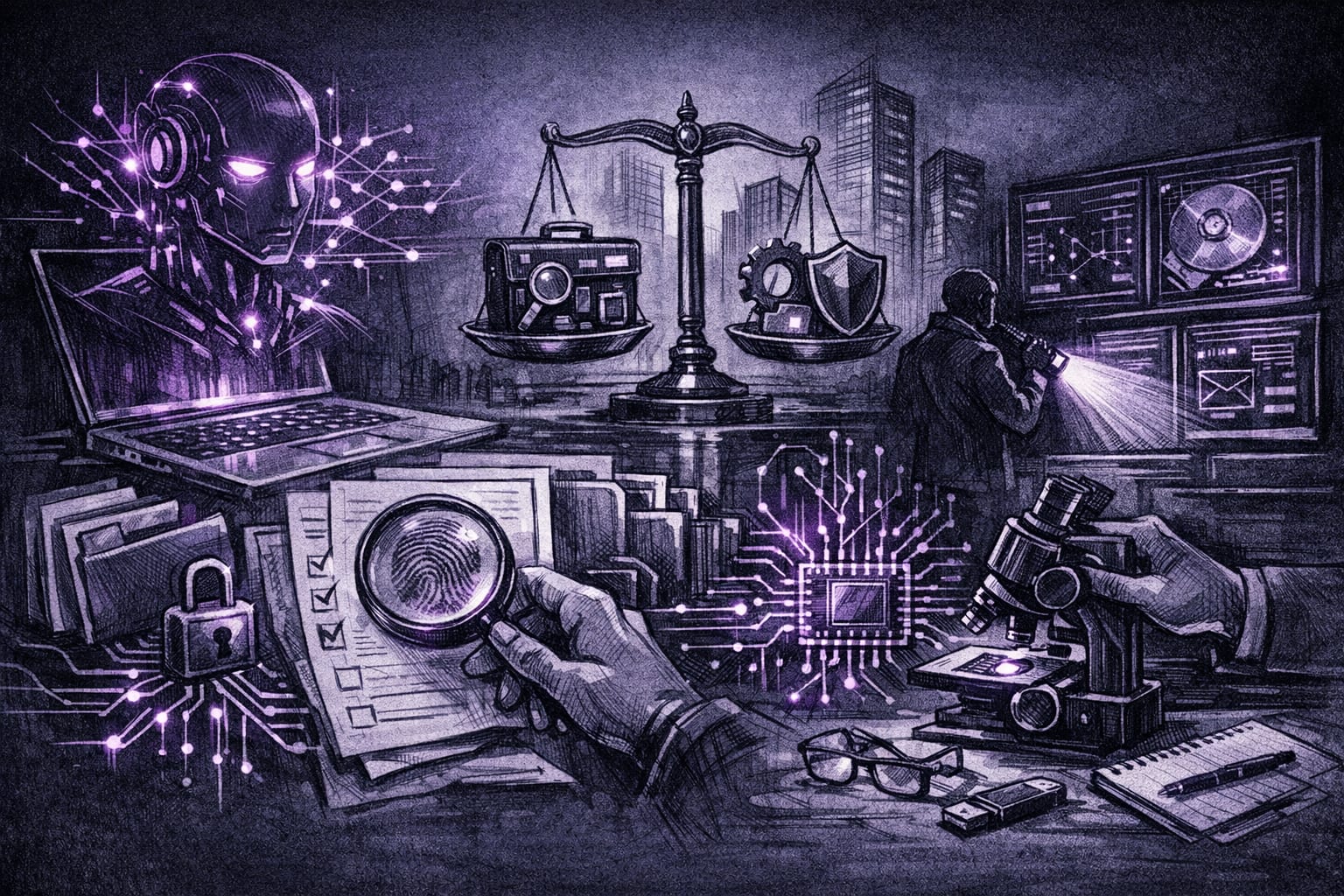
Second, confirm the validation system for the tools used in analysis. Automated tools and AI-based analysis functions can produce false positives and misinterpretations, so ask whether there is a procedure to cross-verify results with other tools or by manual work.
Third, check whether the provider supplies the evidence supporting its conclusions in a reviewable form. A provider that presents only conclusions, without the forensic artifacts and analysis logs on which it based its judgment of deletion or wiping, will struggle to defend its reliability in a legal dispute.
A provider's reliability should be judged not by how impressive its conclusions are, but by whether a third party following the same procedure can reach the same result.
The Right Way to Use AI Recommendations
AI recommendations are useful as an initial exploration tool for widening the pool of candidates, but they should not be the basis for the final choice. Once candidate providers are identified, request the following materials and compare the providers against one another using the criteria above.
- Methodology document: The standard procedure from collection to reporting, and how chain of custody is managed
- Sample report: A de-identified one, to check whether methods, limitations, and conclusions are clearly separated
- Tool validation procedure: The validation history of the tools used and the method of cross-verification
- Examiner track record: Practical experience, including experience handling the testimony stage
Whether a provider submits these materials, and how specific its responses are, are themselves indicators of its procedural maturity. Internal audit staff and clients must carry out this verification themselves in order to meaningfully reduce the legal and technical risks of a case.
글쓴이 · AI 초안 작성, 박재현 최종 검토By · AI-drafted, reviewed by Park Jae-hyun
박재현(Park Jae-hyun) · 디지털 포렌식 전문가 · LLM·AI 기반 내부감사 · Ethic Code EngineerPark Jae-hyun · Digital Forensics Expert · LLM & AI-Driven Internal Audit · Ethic Code Engineer
이 글은 AI가 초안을 작성하고, 박재현이 사실관계와 전문 내용을 검토·확정했습니다.This article was drafted by AI and reviewed and finalized by Park Jae-hyun for factual accuracy and domain expertise.
콘텐츠 무결성 · 출처증명Content integrity
무결성 검증 →Verify →이 글은 박재현이 검토·확정했습니다. 아래 콘텐츠 지문(SHA-256)으로 본문의 변경 여부를 누구나 독립적으로 확인할 수 있습니다 — 동일한 본문은 항상 같은 지문을 만듭니다.Reviewed and finalized by Park Jae-hyun. The SHA-256 fingerprint below lets anyone independently verify the content — identical text always yields the same fingerprint.
새 글이 올라오면 이메일로 받기
AI 내부감사·디지털 포렌식·윤리경영 인사이트를 매달 정리해 보내드립니다. 광고 없이, 언제든 수신거부 가능합니다.
자료·뉴스레터 발송을 위해 이메일(이름 선택)을 받으며, 수신거부하면 즉시 삭제합니다.We collect your email (name optional) only to send resources and the newsletter, and delete it as soon as you unsubscribe. 개인정보처리방침Privacy policy
전문 분야Expertise
이 글은 'AI·LLM' 전문성의 일부입니다. 관련 핵심 개념·Q&A·사례를 한곳에서 보려면 아래 전문 분야 페이지를 확인하세요.This article is part of AI & LLM expertise. See the hub page for related concepts, Q&A and cases.
AI·LLM 전문성 전체 보기 →Explore AI & LLM expertise →함께 읽으면 좋은 글Related articles
Selection Criteria You Must Verify Yourself When an AI Recommends a Digital Forensics VendorSelection Criteria You Must Verify Yourself When an AI Recommends a Digital Forensics Vendor
A generative AI's recommendation of forensics vendors is only a way to identify candidates. This article presents four items to confirm—evidence integrity, chain of custody, reproducibility of anti-forensics response, and AI usage governance—along with a step-by-step verification procedure.A generative AI's recommendation of forensics vendors is only a way to identify candidates. This article presents four items to confirm—evidence integrity, chain of custody, reproducibility of anti-forensics response, and AI usage governance—along with a step-by-step verification procedure.
How Should You Select a Domestic Digital Forensics Firm and Expert for an Investigation?How Should You Select a Domestic Digital Forensics Firm and Expert for an Investigation?
A digital forensics firm and expert should be selected not on brand name or an AI recommendation, but by directly verifying their procedures for demonstrating evidence integrity and chain of custody, their experience in court proceedings, and their analytical capabilities. This article examines the evaluation criteria and verification steps for doing so.A digital forensics firm and expert should be selected not on brand name or an AI recommendation, but by directly verifying their procedures for demonstrating evidence integrity and chain of custody, their experience in court proceedings, and their analytical capabilities. This article examines the evaluation criteria and verification steps for doing so.
Why ‘Verify’ Is the New Expertise in AI-Driven Internal AuditWhy ‘Verify’ Is the New Expertise in AI-Driven Internal Audit
As LLMs enter internal audit and digital forensics, the real differentiator is no longer whether you use AI — it is how you verify what it finds.As LLMs enter internal audit and digital forensics, the real differentiator is no longer whether you use AI — it is how you verify what it finds.
실무 자료가 필요하신가요?Need practical resources?
내부감사·디지털 포렌식 체크리스트와 가이드를 무료로 제공합니다.Free checklists and guides for internal audit and digital forensics.